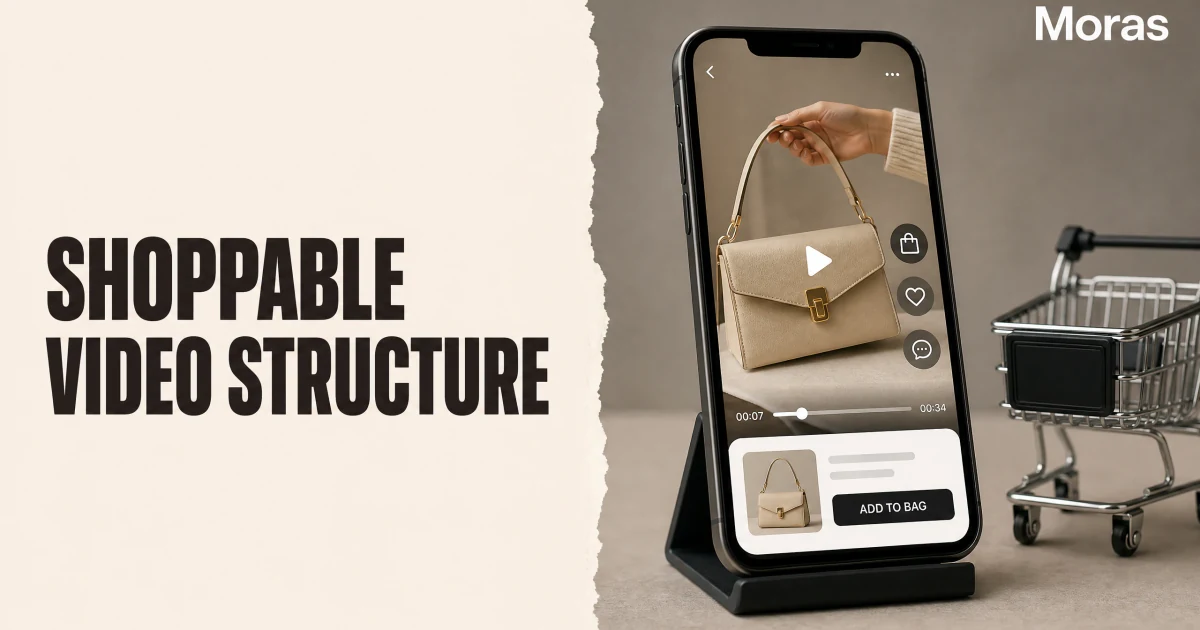
A shoppable video structure is a short sales path compressed into a vertical screen: stop the viewer, make the product legible, prove the claim, create a buying reason, and make the tap feel obvious. It is more than a product video with a link attached. Most low-converting TikTok Shop videos fail because they treat those steps as vibes instead of structure. Moras helps creators move from product research to hook generation, script variants, captions, and repeatable TikTok Shop video production without treating the workflow as a guarantee of sales.
What Makes a Video Shoppable
Firework defines a shoppable video as interactive content that lets viewers purchase products directly from the video experience. Tolstoy's guide to engaging shoppable videos emphasizes the same core idea from the viewer side: the product should be tappable without forcing the buyer out of the moment.
TikTok Shop compresses that idea into a native feed. The product card sits inside the viewing experience. The buyer can tap from discovery to checkout without opening a separate brand site. That is powerful, but it also removes the space a normal product page would use to explain the offer.
So the video has to do more work. It has to carry the product page's headline, demo, proof, objection handling, and CTA before the viewer scrolls away.
That is the reason Moras should sit close to the workflow, not at the end of it. If you use the tool only after writing a finished script, you are using it like a formatter. The better use is upstream: give Moras the product, buyer problem, proof angle, and desired CTA, then generate several shoppable video structures you can test.
The Five-Part Structure
A converting shoppable video usually has five jobs:
| Part | Time window | Job |
|---|---|---|
| Hook | 0-3 seconds | Stop the right buyer |
| Product reveal | 3-6 seconds | Make the SKU immediately legible |
| Proof | 6-18 seconds | Show why the claim is believable |
| Buying trigger | 18-28 seconds | Give the viewer a reason to act now |
| CTA | Final beat | Make the tap obvious |
The timing is not a law. Some products need 12 seconds. others need 45. But in 2026, the order is hard to escape. If you ask for the click before the viewer understands the product, the video feels pushy. If you prove the product before you name the problem, the video feels random. If you wait until the end to show the product, buyers who would have cared may already be gone.
In Moras, this five-part structure is the production brief. Each generated video should clearly map to these parts. If a script has a clever hook but no proof, it is not ready. If it has a CTA but no buying trigger, it will feel like an ad instead of a useful recommendation.
1. Hook: Stop the Right Buyer, Not Everyone
The best shoppable hook is specific enough to repel the wrong viewer. A broad hook like "You need this Amazon find" may earn curiosity, but it gives the algorithm weak buyer signal. A tighter hook like "If your toddler keeps spilling snacks in the car, this tray is the fix" tells TikTok who should see the video and tells the buyer why to stay.
Use one of four hook types:
- Problem hook: name the pain.
- Result hook: show the after state.
- Demonstration hook: start with the product in action.
- Objection hook: admit the doubt the buyer already has.
For products with visible transformation, open on the transformation. For products with invisible utility, open on the problem. For products with trust issues, open on the objection.
2. Product Reveal: Make the SKU Impossible to Miss
Many videos hide the product for too long. That can work for entertainment content, but commerce content needs early clarity. The viewer should know what is being sold before the proof begins.
The reveal can be simple:
- Show the product in hand.
- Put the product next to the problem.
- Show the product card while the item is visible.
- Use on-screen text that names the product category.
Do not rely on packaging. Packaging tells the viewer a product exists. use tells the viewer why it matters. If the SKU is visually confusing, add a close-up and a plain label. If multiple products appear in the shot, highlight the one linked in the card.
3. Proof: Demonstrate the Promise
Proof is where shoppable videos win or lose. Firework's examples include product demonstrations, fashion lookbooks, cooking tutorials, and home decor tours. Tolstoy's tips point to storytelling, key product highlights, interactive features, lively audio, and mobile-first formatting. Underneath those formats is the same conversion question: did the buyer see enough to believe the claim?
Choose proof based on the product:
| Product type | Best proof |
|---|---|
| Cleaning gadget | Before-and-after demo |
| Beauty product | Texture, shade, wear test |
| Kitchen tool | Timed use case |
| Home organizer | Messy-to-organized transformation |
| Apparel | Fit, movement, close-up material |
| Tech accessory | Side-by-side comparison |
Proof should be visual first. A spoken claim can support the proof, but it should not replace it. "This is strong" is weak. Showing the hook hold weight is stronger. "This blends fast" is weak. Showing the texture after ten seconds is stronger.
4. Buying Trigger: Explain Why Now
A buying trigger is not always a discount. It is the reason the viewer should tap instead of saving the idea for later.
Common triggers:
- The product solves a recurring annoyance.
- The price is low enough for impulse purchase.
- The item is seasonal or occasion-based.
- The product replaces a more expensive alternative.
- The video shows a coupon, bundle, or limited availability.
- The buyer can imagine using it today.
Creators often skip this step because they assume the demo is enough. It rarely is. The proof creates belief. the buying trigger creates urgency.
For TikTok Shop, be careful with false urgency. Do not claim scarcity you cannot verify. A better trigger is concrete and honest: "I linked the one with the coupon I used," "This is the travel-size version," or "This is the under-$20 option I kept after testing three."
5. CTA: Make the Tap Obvious
The CTA should remove friction, not add hype. A viewer who wants the product needs to know where to go, which item is linked, and whether the video is showing the exact version.
Strong TikTok Shop CTAs are plain:
- "Tap the yellow cart for the exact one."
- "I linked the size I used in the demo."
- "The coupon showed up for me in the product card."
- "Check the product card before you buy the wrong version."
Pair the CTA with the product on screen. If you say "tap the card" while showing your face and three unrelated items in the frame, the buyer has to do extra work. Extra work kills impulse.
The Mobile-First Rule
Tolstoy highlights mobile-first formatting because most video commerce happens on phones. On TikTok Shop, this is not a best practice. it is the environment. Design every frame for a thumb, a small screen, and partial attention.
That means:
- Use vertical framing.
- Keep the product in the safe area.
- Leave room for the product card and captions.
- Use large on-screen labels.
- Keep cuts legible without sound.
- Avoid tiny comparison charts.
- Show tactile details close up.
Mobile-first also changes pacing. A desktop product video can build atmosphere. A TikTok Shop video has to show the useful part quickly and then layer proof.
Shoppable Video Scripts by Product Type
Problem-Solution Product
Use this for cleaning tools, organizers, repair items, pet products, and kitchen gadgets.
``text 0-3s: Show the annoying problem. 3-6s: Reveal the product in use. 6-18s: Demonstrate the fix with a close-up. 18-25s: Show the finished result. 25-30s: CTA with product card visible. ``
The key is to make the before state recognizable. If the viewer has not felt the problem, the solution feels like a random gadget.
In Moras, this is usually the easiest product type to scale. Generate several versions that keep the same product demo but rotate the problem: messy car, tiny apartment, pet hair, post-cooking cleanup, travel packing. The structure stays fixed while the buyer context changes.
Beauty or Personal Care Product
Use this for skincare, makeup tools, fragrance, hair tools, and body-care products.
``text 0-3s: State the buyer's hesitation. 3-6s: Show texture, shade, or applicator. 6-20s: Apply or demonstrate in real conditions. 20-28s: Show result after wear, light change, or close-up. 28-35s: CTA naming the exact shade or version. ``
Beauty videos need specificity. "So pretty" is not proof. Shade name, skin type, lighting, texture, wear time, and finish help the buyer decide.
For beauty and personal care, use Moras to force specificity into the script. The prompt should include shade, skin type, finish, concern, and the exact visual proof. Generic "you need this" beauty videos are easy to generate and easy to ignore.
Comparison Product
Use this when the SKU competes with a known alternative.
``text 0-3s: Name the expensive or annoying alternative. 3-8s: Show both options. 8-22s: Compare one clear use case. 22-30s: Explain who should choose the linked option. 30-35s: CTA with exact version. ``
Do not compare ten features. Pick the feature that matters most to the buyer: price, convenience, space, speed, durability, or comfort.
This is where Moras can help sellers and affiliates avoid overstuffed scripts. Ask for one comparison point per variant, then test which point earns the most product clicks.
Where Interactive Features Fit
On brand sites and commerce platforms, shoppable videos can include product tags, quizzes, polls, and add-to-cart overlays. TikTok Shop gives creators a more constrained version: product cards, comments, captions, pinned explanations, livestream follow-up, and shop tabs.
Use interaction where it helps the buying decision:
- Product card for the exact SKU.
- Comment prompt for sizing, shade, or use-case questions.
- Caption for searchable terms and key specs.
- Pinned comment for clarification after the video posts.
- Follow-up video for objections that appear repeatedly.
Do not add interaction just because it exists. The best interactive element is the one that answers the buyer's next question.
The Structure Most Creators Should Start With
If you only use one template, use this:
``text Problem in the first frame. Product visible by second three. One clear demo. One objection answered. One reason to buy now. Product card CTA while the product is still on screen. ``
This works because it follows the buyer's mental path: "That is my problem. That is the product. I see how it works. My doubt is answered. I know where to get it." Before producing, score the hook and script for the highest-impact fixes so the first take follows that path.
When you are ready to move from this structure into production, follow the complete product-to-post workflow from product choice through final review and publishing.
Once that version performs, test variations. Change the hook family. Change the proof. Change the CTA. But do not remove the structure until the data says the product needs a different path.
How Moras Turns the Structure into Output
Moras is useful when the bottleneck is producing enough structured variants to learn. A seller or affiliate can take one product, generate several hook families, write proof-driven scripts, and compare which version produces product clicks and commission instead of just views.
Use it after the product is chosen, or use it alongside product research when you are still deciding which SKU deserves a video batch. If the product itself is weak, a cleaner shoppable video structure will only expose that faster. If the product is viable, structure gives the algorithm and the buyer a clearer reason to care.
A good Moras workflow for this article looks like this:
- Pick one product and one buyer problem.
- Generate three hooks for that buyer problem.
- Generate one proof-driven script for each hook.
- Keep the same product card CTA across all three.
- Post the variants and compare product clicks, comments, and orders.
- Use the winner as the next Moras brief.
That is the bridge from blog advice to execution. The article gives you the structure. Moras helps you create enough structured videos to find the version that actually sells.
For product selection, start with our TikTok Shop product research framework. For testing variants after the first batch, use our A/B testing framework for affiliate videos.
For the parent view of format selection before scripting, see the TikTok video formats framework.
Conclusion
The shoppable video structure that converts is simple but unforgiving: hook the right buyer, reveal the product early, prove the promise visually, create a buying trigger, and make the tap obvious. The more friction you remove inside the video, the less work the product page has to do later. In 2026, the winning TikTok Shop video is not the one with the most clever edit. It is the one that makes the purchase path feel natural before the buyer has time to scroll. Moras turns that path into a repeatable production system, so creators and sellers can stop rewriting from scratch and start testing the videos buyers actually respond to. Use the TikTok video generator to turn this structure into multiple shoppable cuts for the same product when that is the next step.