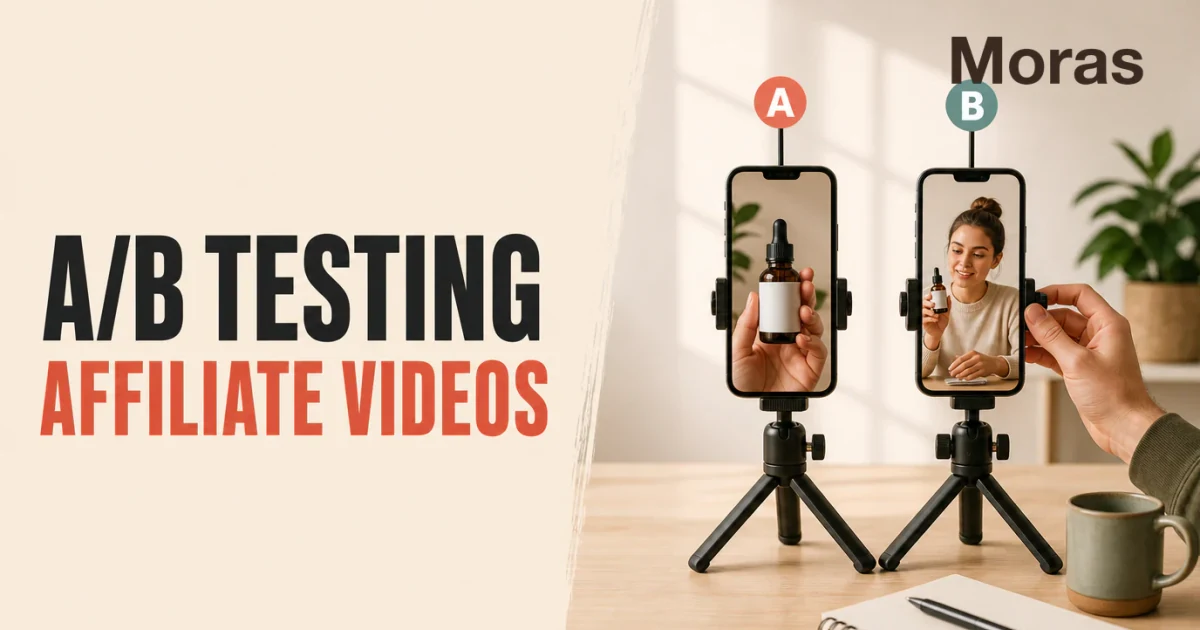
A/B testing affiliate videos means changing one variable at a time, waiting for enough signal, and deciding whether the next edit should target the hook, offer, proof, CTA, or product itself. Most TikTok Shop affiliates change products too early: one video gets 2,000 views and no sales, so they assume the SKU is dead. another gets one commission, so they assume the hook worked. Neither conclusion is useful yet. Moras supports this operating loop by helping creators take one product, generate multiple native TikTok Shop video variants, and turn "I think this hook works" into a repeatable test.
Why Affiliate Video Testing Is Different from Website A/B Testing
Classic affiliate A/B testing usually starts with links, landing pages, and destination paths. Geniuslink's guide to A/B testing affiliate links focuses on splitting traffic between a control destination and a test destination so clicks are compared under the same external conditions. IDevAffiliate's guide to A/B testing for affiliate marketers points to CTAs, media assets, descriptions, subject lines, and landing pages as common testing areas.
TikTok Shop affiliate videos add a layer before the click. Your "landing page" is often the first 3 seconds of the video. Your CTA may be a pinned product card, a spoken line, an on-screen label, and the product tag at the same time. Your traffic source is not a fixed audience on a website. it is an algorithm deciding which viewers see each variant.
That means video testing has to answer two questions separately: did the video earn distribution, and did the distributed video convert buyers? If you mix those together, you will keep the videos that get attention and kill the ones that quietly make money.
This is also why a TikTok Shop testing workflow needs production speed. A classic landing-page test can wait for traffic to accumulate. A creator testing affiliate videos in 2026 needs three to six controlled video variants before the trend window closes. Moras helps here by turning a product and testing goal into hook families, scripts, captions, and repeatable variants without making every test a blank-page writing exercise.
The Control: One Product, One Audience, One Offer
Before testing anything, define the control. For a TikTok Shop affiliate, the control is the current best version of a product video: the hook, angle, proof, CTA, product tag, caption, and posting slot you would use if you were not testing.
Do not start by testing five products against each other. That is not an A/B test. it is product research. A clean test holds the product steady and changes one creative variable. If the product is a mini carpet cleaner, the test might compare a mess-before-cleanup hook against a "things I stopped buying after this" hook. If the product is a lip stain, the test might compare a wear-test angle against a shade-match angle.
Write the control down before posting. Record the product, commission rate, price, hook, first visual, promise, CTA, caption, posting time, and any discount shown in the video. Creators skip this because it feels slow. Then, a week later, they cannot remember whether Variant B won because of the hook or because the product had a temporary discount that day.
In Moras, the control should become the first saved version of the video concept: product, angle, opening line, proof beat, CTA, and caption. Every variant after that should change one named part of the concept. That is how you keep AI-assisted production from turning into a pile of random scripts.
What to Test First
The order matters. Beginners often test captions and hashtags before they test the first visual, even though the first visual decides whether the buyer stays long enough to read anything.
| Test area | What changes | Keep fixed | Primary metric |
|---|---|---|---|
| Hook | First 1-3 seconds | Product, proof, CTA | 3-second hold and click-through |
| Product angle | Reason to care | Product, CTA, length | Product clicks per 1,000 views |
| Proof | Demo, result, comparison | Hook family, CTA | Add-to-cart rate |
| CTA | Spoken or text prompt | Hook, proof, product | Product clicks per 1,000 views |
| Destination | Direct product vs alternate path | Video creative | Earnings per click |
Start with the hook if views are low. Start with the product angle if views are fine but product clicks are weak. Start with proof if people click but do not buy. Start with the CTA only after the video has earned attention and explained the product clearly.
The Five Affiliate Video Variables Worth Isolating
Hook
Hook tests compare the opening promise. The mistake is testing different hooks that also change the audience. "This saved my kitchen" and "TikTok made me buy it" may both fit a cleaning gadget, but they attract different viewers: one is outcome-driven, the other is trend-driven. That can still be useful, but name the audience shift in your notes.
For TikTok Shop, use hook families rather than random one-liners:
- Problem: "If your couch still smells after cleaning, try this."
- Demonstration: "Watch what comes out of this rug."
- Comparison: "I tested the $18 version against the $60 one."
- Objection: "I thought this was another fake cleaning gadget."
- Outcome: "This replaced three tools under my sink."
Each hook family tells the algorithm and the buyer what kind of proof is coming.
First Visual
The first visual is separate from the hook. A strong spoken hook over a weak first frame loses to a silent but obvious demo. Test the image before the words if the product has a visual transformation: dirty-to-clean, flat-to-lifted, messy-to-organized, dull-to-glossy.
For affiliate videos, the first visual should usually show the product in use, the before state, or the outcome. Packaging shots and desk-flat-lays can work after trust exists, but they are weak controls for cold audiences.
Product Angle
The product angle is the reason this SKU matters. It is not the product category. "Portable blender" is a category. "A breakfast workaround for people who leave home before 7 AM" is an angle.
Angle tests are often where affiliate videos find scale. The same product can be positioned as convenience, money-saving, gifting, problem-solving, status, hygiene, travel, or routine upgrade. Keep the hook structure similar while changing the buyer motivation.
Proof
Proof tests compare what makes the claim believable. That could be a live demo, a side-by-side comparison, a before-and-after, a close-up texture shot, a timer, a durability test, a receipt, or a quick objection answer.
If a video gets clicks but no sales, proof is usually the bottleneck. The buyer was curious enough to tap, but not convinced enough to complete the order. That is where an extra demo beat can outperform a louder CTA.
CTA
CTA tests should be boring. That is a compliment. Do not test five different clever phrases. Compare direct prompts:
- "Tap the product card before the coupon ends."
- "I linked the exact one I used."
- "Check the yellow cart for the size I tested."
- "Save this if you are comparing options."
For TikTok Shop, product-card clarity matters more than persuasion. If the viewer cannot tell which product in the video is linked, the CTA failed.
The Metrics That Matter
Views are not the score. They are the size of the room. The score is what happened after the right buyer entered.
Use a simple funnel:
| Funnel step | Question | Useful metric |
|---|---|---|
| Stop | Did the opening earn attention? | 3-second hold rate |
| Stay | Did the video keep interest? | Average watch time or completion |
| Tap | Did the product feel relevant? | Product clicks per 1,000 views |
| Cart | Did the page and price make sense? | Add-to-cart rate |
| Buy | Did the whole path work? | Orders and commission |
| Earn | Was the traffic valuable? | Earnings per 1,000 views or EPC |
Geniuslink argues for earnings per click because it normalizes revenue against click volume. That idea translates cleanly to TikTok Shop, but you need one extra metric above it: earnings per 1,000 views. EPC tells you whether the traffic converted after a tap. Earnings per 1,000 views tells you whether the video was worth posting at all.
Sample Size: When to Trust a Result
Small creators hate this part because it asks for patience. One sale is not a winner. Zero sales is not always a loser. A 50/50 test with 300 total views is just noise wearing a lab coat.
For TikTok Shop affiliate videos, use practical thresholds:
- Do not judge a hook test until both variants have at least 1,000 views or a full 72 hours of normal distribution.
- Do not judge a CTA test until both variants have meaningful product clicks.
- Do not judge a purchase-rate test until the product has enough clicks to make conversion visible.
- Do not kill a product from one failed video unless the product page, price, reviews, shipping, and return risk also look weak.
The lower your traffic, the more you should batch directional tests rather than chase statistical purity. Post three variants in the same hook family, then compare the family against three variants from another family. You are looking for a repeatable pattern, not courtroom evidence.
A Seven-Day Testing Loop
A simple loop beats an elaborate spreadsheet that no one maintains.
| Day | Action | Output |
|---|---|---|
| 1 | Choose one product and write the control | Control notes |
| 2 | Produce two hook variants in Moras | Variant A and B |
| 3 | Post both in comparable windows | Early attention data |
| 4 | Review hold, watch, and clicks | Pick the better hook family |
| 5 | Produce two proof variants using the winning hook | Proof A and B |
| 6 | Post both | Click and cart data |
| 7 | Review commission, EPC, and comments | Next test decision |
The next decision has only four choices: scale the winner, revise the proof, test another angle, or drop the product. Anything more complicated becomes a way to avoid deciding. A practical Moras workflow is to keep one project per product, name each generated video by the variable being tested, and only promote winners into the next batch.
What Not to Test
Do not test a discount that expires halfway through the comparison. Do not test two posting times and call it a hook test. Do not test different products, different audiences, and different CTAs in the same batch. Do not compare a video posted on Monday morning against one posted on Friday night and declare the Friday hook better.
Most bad tests fail because the creator changed too many things and then trusted the result anyway. Good testing is less glamorous: one product, one variable, enough time, clean notes.
How Moras Helps You Run the Test
AI is useful for generating controlled variants. Instead of asking for "more hook ideas," ask for ten hooks in the same family, each using the same buyer motivation and proof structure. That keeps the test clean.
Moras is built around that workflow. Pick a TikTok Shop product, choose the buyer angle, generate several native video scripts, then compare which hook, caption, CTA, and proof beat is worth repeating. The tool should not replace judgment. It should make the experiment cheap enough that judgment has data to work with.
The important part is constraint. Use Moras to generate ten variants of one test, not ten unrelated videos. For example: "same product, same proof, five problem hooks and five objection hooks." That gives you a clean read on the variable that matters. Once a hook family wins, use Moras again to produce proof variants around that winner, then CTA variants around the best proof.
For the upstream product decision, use the framework in our AI product research guide. For the creative layer, pair this testing loop with our TikTok Shop hooks framework.
Run the test after choosing a structure from the TikTok video formats framework, and use the shoppable video structure to keep the conversion job stable while you change one variable.
Conclusion
A/B testing for affiliate videos is not a growth hack. It is a way to stop confusing luck with learning. Keep the product fixed, change one variable, measure the right part of the funnel, and write down what happened. If the video cannot earn attention, test the hook. If it earns attention but not clicks, test the angle. If it gets clicks but no orders, test proof and destination. In 2026, the creator who can generate clean variants quickly has the advantage. That is the practical reason to use Moras: it helps you turn one product into a controlled testing pipeline instead of twenty disconnected guesses. When the next test needs more controlled cuts, use the TikTok video generator to turn one SKU into multiple hook, proof, and CTA variants without rebuilding every video from scratch.