TikTok storytime marketing works when the product's placement feels essential to the story rather than inserted like an ad. The failure pattern is visible everywhere on TikTok Shop: a seller tells a story about their life, and the product appears in the final ten seconds as an afterthought — and converts like an afterthought. The reason is structural, not creative. Narrative formats hold attention up to 55% longer than informational content of the same length, which means a storytime that loses the viewer at the product moment has thrown away the format's entire advantage. This article maps the four-beat narrative shape that keeps the product as the story's resolution rather than its ending, the 60-to-90-second window that the data supports, and the honesty rules that keep a selling story from becoming a compliance violation, for US TikTok Shop affiliates.
The Data That Makes Storytime Worth Getting Right
The reason to learn this format is measurable. SMMNut's 2026 analysis of narrative formats found that storytime and POV content generates 35–55% longer watch time than informational content of equivalent duration, with the advantage concentrated at two specific drop-off points: the 50% mark (where informational content loses viewers who already got the value, while a narrative is at peak tension) and the 75% mark (where a story is building toward its pivot). ContentLabs' video-length research adds the length side: 60–90 second videos average roughly 368,000 views, about 7× the average of 15-second videos, because the algorithm rewards watch time over play count.
Those two findings define the format's economics. Storytime's asset is hold — it keeps viewers watching past the points where informational content loses them. Its liability is the product moment: a story that loses the viewer where the product enters has converted the format's 35–55% advantage into zero. The rest of this article is the structure that makes the hold pay off at the product. (For the format-selection decision — when storytime is the right format for a product at all — our matching framework for TikTok video formats covers the fit. If the narrative puts the viewer inside a scenario rather than following a problem-to-resolution account, compare the POV marketing guide before choosing the opening. This article assumes the format choice and executes it.)
The Narrative Shape That Converts
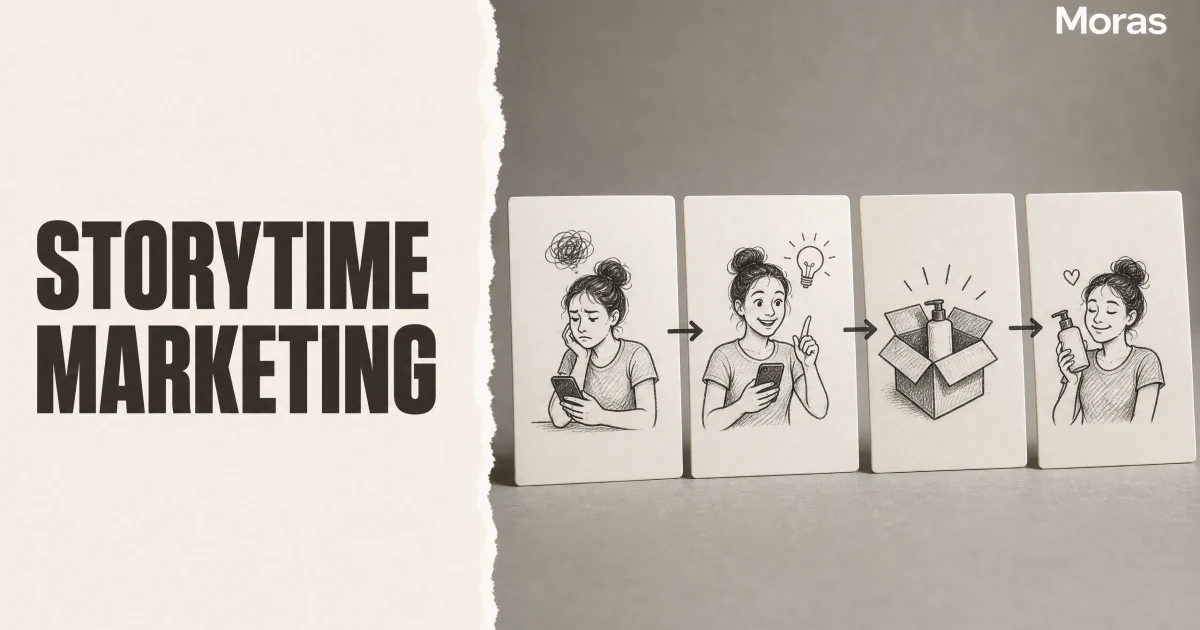
A shoppable storytime rests on one structural principle: the product must be the resolution of a tension the viewer already feels. That requires a four-beat shape, and the product enters at the third beat.
Beat 1: the Problem the Viewer Recognizes
The story opens with a tension the target buyer has felt — not the abstract version, but the concrete event. "The day I dropped red wine on my white couch" beats "I had a stain problem." The recognition is the hook: the viewer stays because the opening describes their own life. The opener does not mention the product. Mentioning it in the first beat converts the story into a pitch and collapses the narrative frame.
Beat 2: the Wrong Turn
The second beat introduces the complication that made things worse — the expensive fix that did not work, the DIY attempt that backfired. The wrong turn is what makes the story real and what makes the product's entry feel like a resolution rather than an insertion. A story that goes "I had a problem, I found this product, it worked" is a three-sentence review dressed as a story. The wrong turn must be honest: TikTok's community guidelines and the FTC's endorsement rules both treat a fabricated personal experience as deceptive when it is presented as your own story to promote a product. (The disclosure rules that apply to endorsements and AI-assisted narratives are covered in our guide to AI content rules on TikTok. the honesty principle applies to human stories equally.)
Beat 3: the Turning Point — Where the Product Enters
The product enters at the low moment — the drawer still will not close, the routine still is not working — as the thing that changed the outcome. This is the insertion point and it is non-negotiable: before beat three, the product has no earned context. after beat three, there is no arc left to resolve. The introduction is also the demo moment — the viewer sees the object, hears the cost, watches the first piece of evidence — which is why the turning point is where the shop link belongs.
Beat 4: the Result and the Close
The final beat shows the resolved state and delivers the call to action. Show the result rather than claiming it — footage of the closed drawer, the cleaned couch. The close is short: price, value anchor, shop ask. A storytime that ends before the result has no payoff. one that drags the result past a single beat loses the viewer at the moment of peak attention.
The Length and Pacing Rules
Storytime's length follows its retention curve. The ContentLabs data shows the 60–90 second range winning on views and engagement across both platforms, and SMMNut's narrative analysis converges on 45–90 seconds for storytime specifically — under 45 seconds there is no room for the wrong turn, over 90 seconds even strong narratives see watch time decline.
The pacing rule is the second half of the formula: every 15–20 seconds, something new must happen or be revealed. A story that holds the same level of tension for longer than 20 seconds gets reassessed as content that is going nowhere, and the viewer exits. The four beats are not four equal blocks — they are four developments spaced so the narrative never idles. This is the difference between a story and a monologue, and it is the rule most selling storytimes break: they front-load the story, then let the product moment sit while the pitch happens.
The length choice also explains why the 2026 trend toward longer content does not apply here. The 2–5 minute videos that win on average views are information formats with known search intent. Storytime is a discovery format: the viewer does not know they need the product until the story creates the need, and attention for an unknown need is short.
Where the Honest Story Comes From
The honesty constraint collides with a practical problem: most affiliates do not have a shelf of product stories waiting to be told. The stories that convert are the ones that are real, and there are four legitimate sources — each with a distinct structure.
The personal use story. The affiliate actually used the product and has a genuine arc — the problem, the failed attempts, the moment it worked. This is the highest-converting story type because it is the only one where the wrong turn is naturally honest, and it is the rarest because most affiliates have not lived it. If you have one, use it. do not fabricate one to fill the slot.
The customer story. A real customer's experience, told with permission and clearly attributed. The arc is the customer's problem, the customer's skepticism, and the customer's result — and the disclosure rules apply to the source: the story is the customer's, not yours, and the endorsement is theirs. This is the version that keeps a seller's product-first catalog honest while still using the narrative format.
The category story. The arc is not about one product but about the category's failure mode — the drawer that cannot stay organized, the routine that cannot hold. The product enters as the resolution to the category problem, and the story's honesty comes from the category being real even when no single personal anecdote is available. This is the safest structure for affiliates without personal experience: the problem is true, the wrong turn is true, and the product's role as resolution is the only claim being made.
The demo dressed as a story. A short demo with narrative framing — "the day I finally tested the gadget I had been ignoring." This is not a story. it is a demo with a story hat, and it converts like a demo while losing the demo's clarity. Use it only when the product has no story-shaped truth — and in that case, reconsider whether storytime is the right format at all. (The format-to-product matching table in our video formats framework is the decision tool.)
The four sources share one discipline: the story you tell must be a story you can stand behind as true. The format's power is identification, and identification is destroyed the moment the viewer senses fabrication — which is also why the comment section is the format's fastest audit.
The Opening Hook Types That Hold the First Three Seconds
The first three seconds of a storytime decide whether the four beats ever get told, and the hook that works for a story is different from the hook that works for a demo. Three story-compatible hook structures cover most product storytimes.
The confession hook names the tension directly: "I was convinced organizers were a scam until last month." The confession establishes the wrong turn before the story starts, which makes the viewer curious about what changed — the exact gap the product will fill at the turning point.
The stakes hook names what was at risk: "I had 48 hours to fix the guest room before my in-laws arrived." The stakes give the story a clock, and the clock gives the pacing rule a natural driver — every 15-second beat can advance toward the deadline.
The specificity hook opens with a concrete detail that signals a real memory: "The drawer had been stuck since March." Specificity is the cheapest credibility in narrative content — a detail no one would invent reads as a memory, and a memory reads as an honest story. This is also the hook most compatible with the honesty rule, because it comes from the actual experience.
The three hooks share the rule from beat one: none of them mention the product. The hook names the tension. the product names itself later, at the turning point, where it has earned the right.
Matching Story Type to Product
Not every story serves every product. The narrative that converts a visible-result product is different from the one that converts a trust-heavy product.
Transformation Stories for Visible-Result Products
Visible-result products — cleaning gadgets, organizers, skincare with a demonstrable effect — convert through transformation stories: "my space was a mess, and here is the moment it stopped being a mess." The wrong turn is easy to source (the failed fix), the turning point is visual (the product acting on the problem), and the result is provable. This is the closest storytime comes to a guaranteed structure.
Credibility Stories for Trust-Heavy Products
Trust-heavy products — supplements, higher-priced electronics — convert through credibility stories: "why I was skeptical, and what changed my mind." The tension is the risk of buying something that might not work. The wrong turn is the skepticism, the turning point is the evidence that overcame it, and the result is the endorsement — which is why these stories carry the strictest disclosure obligations: a first-person credibility story about a product is an endorsement under the FTC's endorsement rules, and the FTC treats fabricated or atypical results accordingly.
Stories That Should Not Exist
Some product categories have no storytime. Commodity items where the buyer's question is price, impulse items under $10 where the decision outpaces a narrative, and products whose only honest story is "I bought it and it was fine" — none have the tension a storytime needs. The format is a vehicle for products with a problem-shaped story. the format-to-product matching table in the video formats framework is the decision tool for whether a story exists to tell.
How to Test a Selling Storytime
Storytime does not A/B test cleanly — a story is a continuous unit, not a set of variable slides. The test is structural: write the same product truth as three different story types — transformation, credibility, and a short demo dressed as a story — and post them a week apart. Compare shop-link clicks and comments per view, not views. A storytime that earns comments but no clicks has a structural failure: the story worked, but the product was not the resolution.
Two signals in the results matter most. First, the insertion point: where the product enters. SMMNut's drop-off data predicts the pattern — if the product enters after the 75% mark, the viewer has already decided whether to stay, and the story has ended before the pitch. Second, the result beat: a visible resolved state outperforms a described one, because the algorithm reads the completed arc and the viewer reads the proof.
How We Researched This
The retention and length data in this article comes from two 2026 sources: SMMNut's analysis of narrative-format watch time (the 35–55% advantage, the 50%/75% drop-off marks, and the 15–20 second pacing rule) and ContentLabs' cross-platform video-length research (the 60–90 second sweet spot and the ~7× view advantage over 15-second videos). The endorsement and disclosure standards are drawn from the FTC's Health Products Compliance Guidance and endorsement rules. This article was prepared by Moras Team, based on analysis of US TikTok Shop affiliate workflows and creator economics data as of July 2026. The four-beat structure and the insertion-point analysis are original analysis, not aggregated from existing blog posts.
Conclusion
Storytime is the format with the largest untapped conversion gap in TikTok Shop content, because its retention advantage is so specific. Narrative formats hold viewers 35–55% longer than informational content — but only if the product moment lands inside that hold. The four-beat structure — problem, wrong turn, turning point, result — keeps the product as the story's resolution rather than its ending. The 45–90 second window and the 15–20 second pacing rule keep the hold alive. Transformation stories fit visible results. credibility stories fit trust-heavy products. and every story must be honest, because the format's power is the identification it builds, and a fabricated story destroys it. The story is not the ad. The story is the reason the ad earns the right to exist — and the product is the answer the story has already made the viewer need.
Once the story shape is chosen, the production step is mechanical: script, shots, edit, publish. Turn the winning story angle into a finished shoppable video and test the next angle the same way.