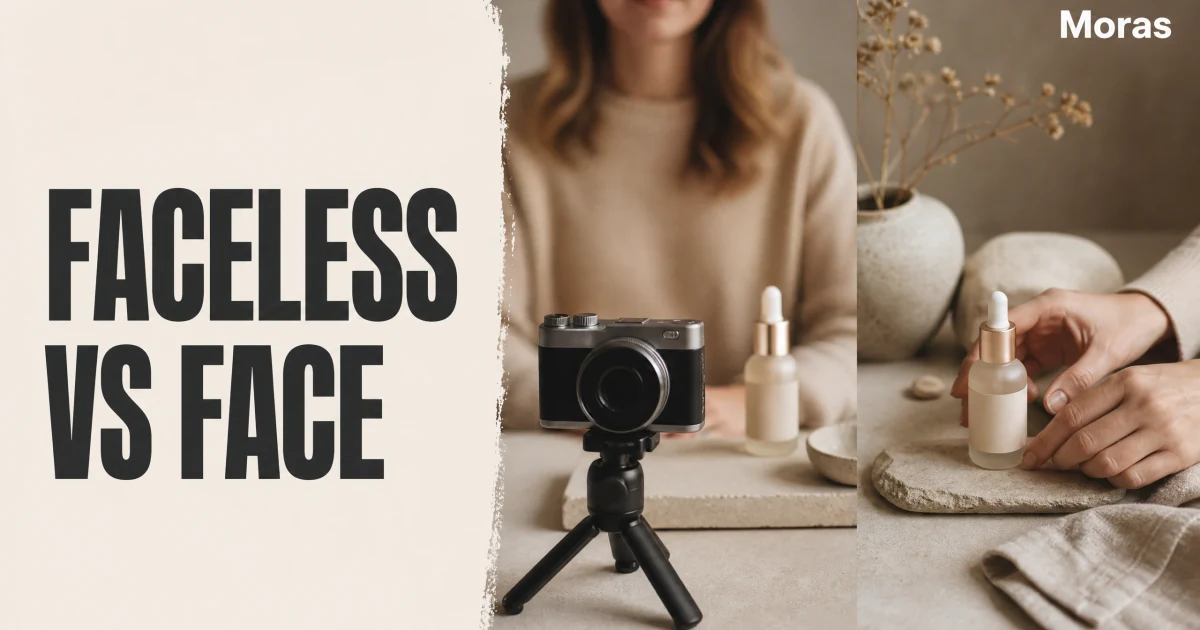
Faceless TikTok Shop affiliates can succeed without showing their face, but the format has to match the product's trust load and the platform's content rules. The advice that travels fastest is also the advice most likely to waste a limited evening: show your face, talk like a friend, post daily. That works when presenter trust is the main conversion variable, but it fails when a product sells on visible demonstration, when your day job leaves 90 minutes, or when appearing on camera is a privacy non-starter. Faceless vs face on camera TikTok Shop affiliate content is a category-and-constraint decision. This framework helps US affiliates choose faceless, face-on-camera, or hybrid formats before committing to a production routine.
Why "Just Show Your Face" Fails as a Universal Rule
If you read ten TikTok Shop affiliate threads in 2026, nine will tell you that face-on-camera content outperforms everything else. The tenth will tell you faceless is dead. Both camps are reporting real observations from incompatible sample sizes — and neither camp starts by asking what the product category requires the viewer to believe before they tap the shopping bag.
Face-on-camera content earns its cost when the presenter's identity carries information the product cannot — judgment on ingestibles, experience timelines, or physical fit. A collagen powder does not become more trustworthy because the B-roll is crisp. A shapewear SKU does not become more honest because captions are well timed. The viewer needs a human signal — preferably real skin, measurements, or timeline specificity — on TikTok's vertical feed.
Faceless content earns its cost when the product's function is visible in three seconds and the purchase is impulse-driven. Kitchen gadgets, cleaning before-and-afters, and obvious-utility accessories reward hook specificity and visual proof density, not charisma. TikTok Shop's US affiliate ecosystem, which Reuters reported crossed $15.8 billion in GMV in 2025, pays for posts that convert — and conversion physics differ by SKU more than by production aesthetic.
This article is a decision framework, not a filming tutorial. It will not walk through AI voiceover workflows, stock-footage assembly, or link-to-video automation — those production paths are mapped in our guide to TikTok Shop videos without filming. The question here is narrower and earlier in the workflow: given your category, your time budget, and your privacy constraints, should you build a face-forward account, a faceless demo account, or a hybrid that uses each format where it actually wins?
The Three Variables That Decide Face vs Faceless
Most affiliates who struggle with this decision are comparing the wrong things — editing polish, follower count, or whether their favorite creator shows their face. Three variables actually determine the answer. Run them in order. each one narrows the field before you touch a camera or an AI tool.
Variable 1: Trust Load — What Must the Viewer Believe?
Trust load is the weight of personal judgment in the purchase decision. Low trust-load SKUs sell when the viewer believes the product demonstration — the stain lifts, the drawer organizes, the cable charges faster. High trust-load SKUs sell when the viewer believes the recommender — this serum will not irritate my skin, this powder will not interact badly with what I already take, this size will fit my frame.
The honest test, borrowed from our analysis in AI custom avatar videos: if you removed the presenter and kept the same demo footage and script, would conversion meaningfully drop? If no, you are in faceless-primary territory. If yes, you need a presenter layer — and the next question is whether that presenter must be you, a hired creator, or a labeled synthetic presenter, not whether you prefer voiceover.
Trust load also splits within categories. Beauty content about packaging, application technique, or dupe comparisons is often low-to-medium trust load — the texture on screen carries proof. Beauty content about sensitive skin, shade matching, or outcome claims is high trust load — a faceless voice reading "this cleared my acne" is both a conversion weak point and a compliance risk under TikTok's health-content rules and the FTC's endorsement guidance, as summarized in our TikTok AI content rules guide.
Variable 2: Time Budget — What Can You Sustain for 60 Days?
A face-on-camera affiliate workflow has hidden time costs that faceless workflows do not. Hair, lighting consistency, retakes because you stumbled on the product name, the psychological friction of filming after a long day job — these are not vanity concerns. They are throughput constraints. A typical side-hustle timeline assumes 60 to 90 minutes daily for someone with a day job: roughly 30 to 40 minutes to script and record one to two shoppable videos, plus research and analytics. That budget accommodates face filming if your setup is dialed in and your category rewards it. It does not accommodate a 45-minute retake loop on every post while you test five niches.
Faceless and hybrid workflows trade presenter time for hook-and-demo judgment time. You still need strong opening frames and accurate captions — faceless is not "easier content," it is different labor. The time variable does not automatically pick faceless. It picks whichever format you can post consistently for 60 days without burning out in week four. An affiliate who posts five faceless demos weekly for 90 days will beat an affiliate who posts three face videos in week one and zero in weeks five through eight.
Variable 3: Privacy and Identity — Non-Negotiable Constraints
Some affiliates cannot appear on camera — employer policies, family privacy, or zero desire to tie income to their face. This is a hard constraint, not a skill gap. It eliminates face-primary workflows unless you outsource to UGC creators or use disclosed synthetic presenters.
Privacy constraints push toward pure faceless demos, custom avatar layers with full disclosure, or commissioned UGC. Pure faceless often suffices for gadgets. avatars fit when you want presence without daily filming — see our AI custom avatar videos guide. UGC is the default when categories demand real skin, fit, or documented experience. Do not use synthetic testimonial formats to bypass the constraint — an AI face claiming "this changed my life" without real experience is a compliance problem, not a shortcut.
Category Decision Matrix: Beauty, Supplements, Gadgets, Apparel
Generic "faceless vs face" debates collapse the moment you compare a $14 kitchen tool to a $48 collagen tub. The matrix below is the core decision tool for US TikTok Shop affiliates. "Primary" means the format that should carry most of your posting volume after a 30-day validation test. "Conditional" means match the claim type or sub-SKU. "Weak" means default away unless your data proves an exception.
| Category | Faceless-primary | Face-on-camera primary | Hybrid (recommended pattern) | Why the split exists |
|---|---|---|---|---|
| Beauty (skincare, makeup tools, hair) | Conditional — dupes, haul aesthetics, satisfying application without outcome claims | Conditional — sensitive skin, shade match, ingredient judgment | Strong default — voiceover or text hook → close-up demo. face only on claim-light routines | Texture and application can be faceless. outcomes and shade trust need human proof |
| Supplements (powders, gummies, wellness adjacents) | Weak — high compliance + trust bar | Strong — real presenter with sourced, limited claims | Face for credibility segments. faceless only for ingredient education slides without efficacy promises | Buyer anxiety is ingest + health interaction. synthetic or voice-only claims underperform and attract scrutiny |
| Gadgets (kitchen, cleaning, phone accessories) | Strong default — demo IS the sell | Conditional — spec-heavy items over ~$60 where judgment matters | Hook (voice or short face) → silent/captioned product demo | Visual proof density beats presenter charisma for most impulse SKUs under $30 |
| Apparel & fit (shapewear, shoes, sizing) | Conditional — flat-lay, fabric detail, styling without fit claims | Strong — try-on, size reference, movement on body | Flat-lay discovery → try-on conversion posts on winning SKUs | Fit honesty cannot be faked with stock footage. return rates punish vague faceless fit implied |
Two patterns fall out of the matrix that listicles rarely state explicitly. First, beauty and supplements split by claim type, not by category label — showing packaging and technique is faceless-compatible. claiming results on skin or body is face-or-UGC territory. Second, gadgets reward hybrids at volume — the highest-throughput affiliate pattern we observe is a two-second spoken or text hook, then product-only demo footage with captions carrying specs. The face (if any) starts attention. the demo closes the sale.
Before you commit to a row in this table, confirm your niche within the category. A "beauty" affiliate selling jade rollers faces different trust load than one selling prescription-strength retinol adjacents. Niche tightens the matrix. choose a sub-category you can post consistently for 60 days.
Beauty: When the Face Earns Its Keep
Beauty affiliates face the most nuanced fork because the same TikTok Shop category contains both low-trust-load dupes and high-trust-load treatment products. Faceless works when the video's promise is visual and immediate — pigment swatch on arm, satisfying cream texture, brush application from a flat lay. The viewer learns enough from the first three seconds to justify a sub-$25 impulse buy.
Face-on-camera works when the promise is personal compatibility — "I have rosacea and this did not sting," "shade 180 matches neutral undertones," "this is week three of my retinol routine and here is what flaked." Those sentences require a real timeline and a real face unless you are paying UGC creators to supply them. Custom avatars occupy a narrow middle ground for routine demonstration without outcome claims — application sequences where the synthetic presenter is labeled and the product texture remains visible in B-roll. They fail as primary format for shade matching and skin reactions because viewers correctly treat synthetic skin as non-evidence.
Supplements: Why Faceless-Primary Is Usually the Wrong Default
Supplements are the category where affiliates most often misapply faceless production speed. The product photo is fine. The AI voiceover is polished. The hook mentions sleep, energy, or gut health. Conversion still flatlines — because the viewer's unanswered question is not "what does the tub look like?" but "why should I trust you about what I put in my body?"
Face-on-camera does not mean exaggerated health claims. It means identifiable judgment with bounded statements — ingredient literacy, personal timeline with limitations, comparison to products you actually used. Faceless can support supplement affiliates only in strictly educational angles: explaining what magnesium glycinate is without implying your video viewer should expect the same outcome. The moment the script crosses into testimonial territory, you need a real human signal or purchased UGC — not a faster voiceover pipeline.
Return rates and commission clawbacks make this category especially punishing for misleading faceless demos. A video that drives clicks but sends buyers who feel deceived will cost you twice — once in returns, once in weakened account trust signals.
Gadgets: Faceless Default with Hybrid Upgrades
Gadget affiliates are the clearest faceless-primary case in US TikTok Shop — and the category where hybrid formats most often beat both pure face and pure slideshow. The conversion variable is visual proof in the opening frame: the gadget doing the one thing it claims. Presenter identity rarely adds information for a $12 kitchen tool or a cordless cleaner under $40.
Face-on-camera becomes conditional when price and complexity rise — a $120 skincare device, a multi-mode air purifier, a phone gimbal with learning curve. Here the presenter carries judgment and comparison, not just enthusiasm. The hybrid pattern that scales: faceless or voiceover hook testing at volume on three to five hero SKUs, then a single face-forward explainer on the winner if click-through rate stalls below 2% despite strong view counts. That sequence respects time budgets while letting data override the default.
Apparel: Fit Honesty Beats Production Polish
Apparel is where faceless-primary affiliates lose money quietly through returns. Flat-lays and detail shots work for discovery — fabric texture, pattern, styling ideas. They fail for conversion on fit-sensitive SKUs — shapewear, bras, shoes, petite/tall sizing. The viewer needs size reference on a body that resembles theirs, or explicit measurement callouts on a real try-on.
Hybrid apparel affiliates often run faceless styling content for reach and face-on try-on content for the same SKU's conversion posts. That is not inconsistency. it is format matching to funnel stage. If privacy rules out your face entirely, budget for micro-UGC try-on clips on hero products rather than faceless implied-fit videos that drive returns.
Hybrid Patterns That Beat Pure Face or Pure Faceless
Pure format identity — "I am a faceless account" or "I always film myself" — is a branding choice, not a conversion strategy. The affiliates who compound commission fastest treat format as per-video variable tied to claim type and funnel stage. Four hybrid patterns appear repeatedly across US TikTok Shop categories in 2026.
Pattern 1: Hook voice, demo body. Two to four seconds of spoken or text hook — often faceless or over-the-shoulder — then mute the presenter and let product footage carry the middle with captioned specs. Common in gadgets and cleaning categories. The hook supplies scroll-stop. the demo supplies proof.
Pattern 2: Face intro, product-only middle. Presenter appears in the first five seconds to establish "real person recommending," then cuts to hands-only demonstration for the remaining 20 seconds. Common when trust load is medium — the face answers "who is this?" without requiring full talking-head retention for the entire clip.
Pattern 3: Faceless discovery, face conversion. Same SKU, two post types: faceless haul or listicle for reach, face or UGC try-on for the shoppable post with product tag emphasis. Common in apparel and beauty when the affiliate can appear on camera but not daily.
Pattern 4: Synthetic presenter intro, labeled demo outro. Disclosed AI or custom avatar opens with category-safe framing — "AI presenter · real product demo below" — followed by listing-accurate B-roll. Conditional in beauty routines. weak for supplements with efficacy angles. Full disclosure stack per our AI custom avatar videos guide and TikTok AI content rules guide.
Hybrids fail when they are accidental — a faceless body with a testimonial script, or a face intro that promises outcomes the demo never substantiates. Each segment should carry one trust job. Mixing jobs within a segment is what produces videos that get views and generate returns.
When Starting Constraints Should Override the Matrix
The category matrix is a default, not a sentence. Three starting conditions legitimately override it.
Day job with 90 minutes daily. If the matrix says face-primary but your sustainable output is three face videos per week, downgrade to hybrid or faceless-primary until you have one hero SKU with proven click-through rate — then invest face time on that SKU only. The side hustle validation sequence is built for this constraint: 60 days of consistent posting matters more than format prestige.
Zero camera willingness. If face and UGC are both off the table, eliminate high-trust-load categories from your shortlist — supplements, fit apparel, outcome-heavy skincare — rather than forcing faceless scripts into categories that need human proof. Reframe niche choice, not disclosure loopholes.
Existing face-forward audience. If you already have recognition from lifestyle content, face-on-camera may compound account equity even in gadget categories where faceless would convert fine for a new account. The variable is audience expectation, not category physics alone.
Sample access limitations. Affiliates without product in hand can still run faceless screen-record or listing-footage workflows for some gadgets, but cannot honestly run face try-on or experience-based supplement content. Constraint picks format and eligible SKUs together.
How to Validate Your Format Choice in 30 Days
This section is a test design, not a production checklist. Once you pick a default format from the matrix, validate it with matched posts before you rebuild your entire workflow.
Pick one product in one sub-niche. Post six videos over 14 days in your chosen default format — faceless-primary, face-primary, or hybrid Pattern 1. Match hook structure across posts. vary only the demonstration angle. Track views past 500 (algorithm breadth signal), product-tag click-through rate, and commission events per post. If click-through rate stays below 1% with views above 500, the bottleneck is likely demonstration clarity, not face presence — fix hooks and proof before switching format.
Run a format fork in days 15 through 30: three posts in your default format, three posts in the alternate format on the same SKU with matched hooks. Compare click-through rate, not vanity views. If the alternate format beats default by 50% or more on CTR across matched pairs, shift primary volume — do not abandon default entirely. hybrid may be the actual winner.
If both formats stall, the issue is probably product-audience fit or niche saturation, not face vs faceless. Return to our niche selection guide and product research signals before buying avatar subscriptions or ring lights.
For hook mechanism alignment by category — independent of face choice — see our TikTok Shop hooks framework. For execution after validation, faceless production paths live in videos without filming. synthetic presenter paths in our AI custom avatar videos guide. During seasonal peaks, pair this format decision with the TikTok Shop Black Friday affiliate playbook so your production lane matches the posting window.
Conclusion
Faceless vs face-on-camera for TikTok Shop affiliate content is a category-and-constraint decision, not a personality test. Trust load tells you whether the viewer needs to believe the product or the presenter. Time and privacy tell you whether face-primary workflows are sustainable or even allowed. The beauty, supplement, gadget, and apparel matrix gives defaults. hybrid patterns — hook voice with demo body, faceless discovery with face conversion — often beat pure formats at realistic post volumes. It belongs in the wider affiliate operating map covered by our TikTok monetization overview.
Choose a default from the matrix, validate with matched 30-day tests on one hero SKU, and shift volume based on click-through data — not on what a screenshot creator posted about their best month. Once the decision is clear, production belongs in the linked guides: faceless execution in our TikTok Shop videos without filming guide, synthetic middle paths in our AI custom avatar videos guide, niche tightening in our TikTok Shop niche selection guide. Get the format decision right first. optimize rendering second.